 Science On a Sphere
History of SOS and SOSx
Science On a Sphere® (SOS) was invented by Dr. Alexander “Sandy” MacDonald (NOAA Research) in 1995 as an outgrowth of other visualization projects. Since then, the program has grown and there are now Science On a Sphere installations in 31 countries and 35 U.S. states. A flat screen version of SOS was released in 2015 and continues to evolve. The program is managed by NOAA’s Office of Education.
Dr. Sandy MacDonald served as the director of the NOAA Earth System Research Laboratory in Boulder, CO, and NOAA Research Deputy Assistant Administrator for Laboratories and Cooperative Institutes before retiring.
History of SOS
Permalink to History of SOSAn early prototype of Science On a Sphere® was built in 1995, followed by an effort to develop a complete system beginning in 2000. David Himes was the original lead software engineer on the project who, along with others in NOAA Research, engineered, developed, and integrated all of the software and hardware components used to create the Science On a Sphere® system. A patent was awarded to NOAA for Science On a Sphere® in August 2005, with Dr. MacDonald credited as the inventor.
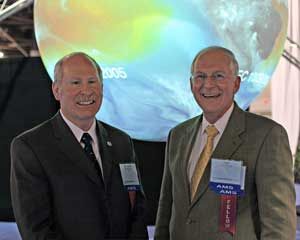
Science On a Sphere inventor Dr. Sandy MacDonald (left) with former director of the National Hurricane Center, Dr. Max Mayfield (right).
Science On a Sphere® is a large visualization system that uses computers and video projectors to display images onto the surface of a sphere. When used to show planetary data, SOS becomes an animated globe, displaying dynamic, animated images of Earth and other planets’ atmosphere, ocean, and land surface. NOAA primarily uses SOS as an education and outreach tool to describe the environmental processes of Earth.
Science On a Sphere® was initially developed as a way to explore environmental data using new visualization techniques. It became quickly obvious that when combined with the narration and supporting educational material, a well-crafted visualization provides a unique and powerful teaching tool. Over the past 20 years, NOAA has been using SOS to support educational initiatives, primarily in informal education venues, such as those found in science centers and museums.
Science On a Sphere® is built from standard hardware components including off-the-shelf PCs, video projectors, wires, and a sphere. The PCs run a version of Ubuntu Linux. When installed in a room, the sphere is generally suspended from above and surrounded at the corners of the room by four video projectors. Only one computer is required to operate the whole exhibit, with a second computer as a backup. Data is pulled from the disk, manipulated, re-projected, and synchronized back onto the sphere.
While the interactions between all of the hardware pieces are complicated, using the system is easy and straightforward. The system comes pre-programmed with various data sets that show the Earth’s land, ocean, and atmosphere, to name just a few. The data sets are organized into categories such as land, air, water, and space and then further sorted into subcategories. Datasets can also be organized into presentation playlists. An SOS presentation playlist is analogous to the MP3 player concept of a playlist. The items in a playlist can be randomly selected or played in sequence. The system allows for an unattended (or automatic) mode of operation or it can be controlled via the SOS Remote App.
Enhancements and new features are continually added to SOS to ensure that it remains at the forefront of educational visualization displays. Recent enhancements include compatibility with 4K projectors, a selection of sphere sizes, the ability to use fewer projectors, the Visual Playlist Editor, and the SOS Public Kiosk. Check out the SOS Product Suite for full details on the software enhancements.
Seeing the educational value in SOS, NOAA’s Office of Education partnered with the developers in NOAA’s research office to expand the potential of SOS in the early 2000s. They created the Science On a Sphere Users Collaborative Network, which is composed of institutions who use SOS in an educational setting. Supported by NOAA’s Office of Education, the network has worked to establish guidelines for creating effective content for spherical display systems. The network has also been heavily focused on evaluating the effectiveness of content delivery via the SOS system.
The SOS network works to maximize the effectiveness of the Science On a Sphere as an Earth system science education platform. Now, in addition to email distribution lists and online discussion forums, the SOS network also meets in-person approximately every 18 months to share ideas.
In 2021, the SOS program was transferred from NOAA Research to NOAA’s Office of Education, allowing for an even deeper focus on education in development of new features and offerings. The education section of the website has many of these resources available. As part of this transition, the project is now also co-managed by the Center for Education, Engagement and Evaluation at the Cooperative Institute for Research in Environmental Sciences at the University of Colorado.
For more information on Science On a Sphere®, you can read the article NOAA’s Science On a Sphere Education Program.
History of SOSx
Permalink to History of SOSxSOS Explorer® was developed by the Global Systems Laboratory in NOAA Research, which is also where Science On a Sphere® (SOS) was created. Wanting to build off of the success of SOS and expand the reach of SOS into classrooms and homes as well as museums who don’t have the physical space for a full Science On a Sphere®, developers created a flat screen version of SOS called SOS Explorer® (SOSx).
Several factors came together at the right time to result in the development of SOSx. After field trips to see NOAA’s popular SOS, many teachers often asked how they could bring the same experience of viewing global data into their classrooms. Most teachers didn’t have a budget - or the space! - for installing SOS into their schools and needed other options. A flat screen version that could be displayed on computer monitors and projectors seemed like an obvious solution. At the same time, developers at NOAA were working on Terraviz™, a visualization engine that utilizes gaming technology to generate high resolution displays. As part of their work, they were using Terraviz to create a virtual globe that scientists could use to display and analyze global weather models. As the technology matured and education changed, SOS Explorer expanded to include a free mobile application.
SOS, SOS Explorer and SOS Explorer mobile are the software products in the NOAA SOS Program. To understand how they are similar and different, see our product lineup.
Evolution of the SOS Program
Permalink to Evolution of the SOS Program- 1995
- Early prototype of Science On a Sphere® built by Dr. Sandy MacDonald
- 2004
- First permanent SOS installation
- 2005
- SOS patent awarded
- 2006
- 1st SOS Users Collaborative Network Workshop, Maryland Science Center, Baltimore, MD
- 2006
- 10th SOS installed
- 2007
- SOS Data Catalog reorganized
- 2008
- 25th SOS installed
- 2008
- 2nd SOS Users Collaborative Network Workshop - Bishop Museum and 'Imiloa Astronomy Center of Hawai’i, Honolulu and Hilo, HI
- 2008
- Wii remote introduced for controlling SOS
- 2009
- SphereCasting introduced
- 2009
- 3rd SOS Users Collaborative Network Workshop - Fiske Planetarium and Science Center, Boulder, CO
- 2010
- 50th SOS installed
- 2010
- SOS hardware requirements changed from five computers to one
- 2011
- 4th SOS Users Collaborative Network Workshop - Museum of Science and Industry, Chicago, IL
- 2011
- 75th SOS installed
- 2011
- SOS Remote iPad App introduced for controlling SOS
- 2012
- Annotation, Zoom, and Layers introduced
- 2012
- 5th SOS Users Collaborative Network Workshop - Aquarium of the Pacific, Long Beach, CA
- 2013
- 100th SOS installed
- 2013
- Support for KML (keyhole markup language) and WMS (web map service) files introduced
- 2014
- Usage Statistics and Live Video PIPs introduced
- 2014
- 6th SOS Users Collaborative Network Workshop - Science Museum of Minnesota, St. Paul, MN
- 2015
- 125th SOS installed
- 2015
- SOS Explorer Lite launched
- 2015
- Experimental Auto-alignment, Translations, and Kiosk introduced
- 2015
- 7th SOS Users Collaborative Network Workshop - Oregon Museum of Science and Industry, Portland, OR
- 2016
- Fully featured Visual Playlist Editor introduced
- 2016
- SOS Explorer launched
- 2017
- Text PIPs introduced
- 2017
- 8th SOS Users Collaborative Network Workshop - Detroit Zoo, Royal Oak, MI
- 2017
- 150th SOS installed
- 2018
- Moving PIPs and Captions introduced
- 2018
- 9th Collaborative SOS Workshop - Science City at Union Station, Kansas City, MO
- 2019
- Projector Control introduced
- 2019
- 175th SOS installed
- 2019
- SOS Explorer Mobile App launched
- 2020
- 10th SOS Users Collaborative Network Workshop - Virtual
- 2021
- New website launched
- 2021
- SOS Program transitions to the NOAA Office of Education
- 2022
- 11th SOS Users Collaborative Network Workshop - Virtual
- 2023
- SOS upgraded to the latest Ubuntu operating system
- 2023
- SOS Explorer Mobile support for Chromebooks released
- 2024
- 200th SOS installed
- 2024
- Free version of SOS Explorer released
- 2024
- 1st Environmental Literacy Program and SOS Joint Workshop - The Wild Center, Tupper Lake, NY